
Checking for a Warrant in Charleston County
Start with the Charleston County Sheriff’s Office warrant search, the county’s own public lookup. It takes a last name and allows a first name too. Treat it as a lead, not a full court index. Jot down when you searched. Then call the Warrants Unit at (843) 529-7391 to confirm a possible match or to ask which court holds the file. Missed a city ticket or ordinance date instead? Call the city court named on the citation, since the Sheriff’s countywide form may miss a municipal bench warrant. The Charleston County Public Index adds General Sessions case context, though it cannot replace a status check with the issuing court.
- Identify the court or agency printed on the ticket, notice, or case paper.
- Use that office’s official search, if one is offered.
- Confirm a possible result with the Warrants Unit or issuing clerk.
- Ask about counsel, appearance, bond, payment, and the next date before acting.
The sheriff's own warrant-search form is online, cautions included. Open the official search screen before typing a name into a Charleston County lookup.
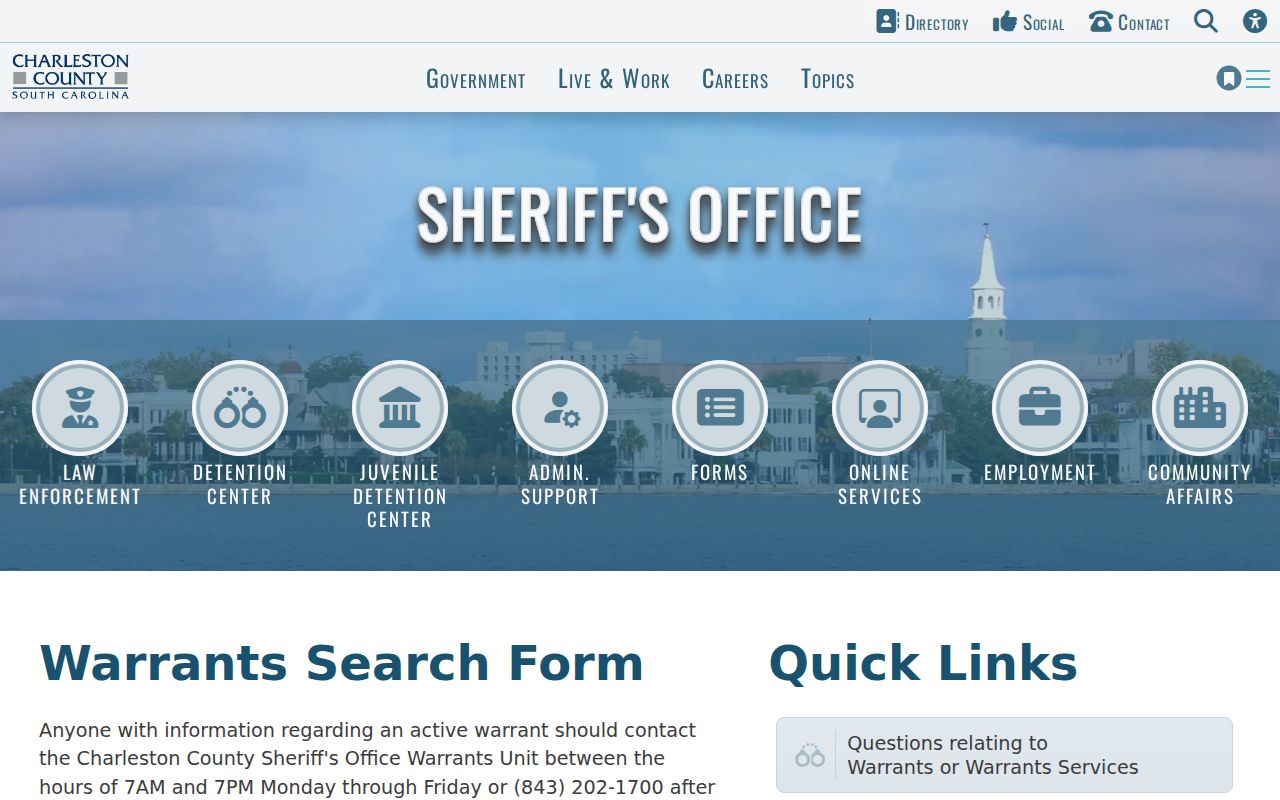
Treat any Charleston County result as a first check only, then confirm a possible match with the Sheriff's Warrants Unit.
Charleston County Search Scope
The CCSO form gives you only two public search fields. No date-of-birth, charge, municipality, or warrant-number filter exists. That limits a Charleston County warrant lookup in real ways. A common last name can pull up a stranger's record, while spelling changes, aliases, recent court action, or delayed data can hide one entirely. Never decide a result is yours from a name alone. Match the record type to the right system. General Sessions case context lives in the Public Index. Magistrate and municipal warrants in Charleston County may sit with their own court instead. Traffic matters can begin in a city portal or the state Judicial Branch ticket search, which is not a complete warrant repository.
| Channel | Useful For | Limit |
|---|---|---|
| CCSO warrant search | Publicly releasable Sheriff warrant leads | Last name required; not confirmation |
| Public Index | General Sessions and available court context | Not live service status |
| City court | Municipal tickets and city warrants | Rules vary by city |
Charleston County Warrant Types
Charleston County records do not sort into one warrant class. A magistrate may issue an arrest warrant. A bench warrant can follow a missed hearing, municipal courts handle city ordinance process, and traffic cases may produce appearance-related warrants. Family Court runs its own process, and federal cases stay in federal court. A type label points to the right office. South Carolina paperwork in Charleston County uses "bench warrant after failure to appear," "bench warrant," and "warrant for arrest." "Capias" is not the usual public label here. Status words matter too. Served, returned, recalled, quashed, satisfied, and expunged each describe a different action, and a returned warrant is not the same as a court order recalling it.
- Bench warrant
- Court process often tied to a missed date or order.
- Recall or quash
- A court action that withdraws or sets aside process.
- Bond
- A release condition set by a judge or court process.
- Returned
- A service record sent back to the issuing court.
Ask the Charleston County clerk of the issuing court which term sits on the file and what action remains due.
Inside a Charleston County Warrant Record
A warrant file can have several layers. The court's order, a case docket, an affidavit, a Sheriff service record, and later actions such as service, return, recall, or bond may all exist. An online lead usually shows only a small public subset. The court file and the Sheriff operational file answer different questions. Match the issuing court and case context first. Treat any sample number as a format illustration only. Charleston County's public materials do not establish one countywide number format for every court.
| Warrant number | Use the number printed on your own court paper |
|---|---|
| Issuing court | Shows which clerk or judge controls the next procedure. |
| Charge or reason | Summarizes the matter; the public view may omit supporting detail. |
| Service status | Ask whether it is current, served, returned, or recalled. |
| Bond or next date | Confirm terms with the court before paying or appearing. |
Charleston County Case Context
The Public Index helps once you hold a General Sessions case number. It also works for locating a court event. A warrant number even fits the case-number field. Name, date-range, and action filters narrow things further. Find your case. Then ask the Clerk of Court or the issuing judicial office about current warrant status in Charleston County. The index itself cautions that data may be incorrect or not current. Beginning January 1, 2026, it stops displaying home addresses. A written process covers requests to redact sensitive information. Automated scraping is barred too. Use the search as an individual case-reference tool for Charleston County, and do not copy results into any public list. Read the Public Index search instructions before relying on any field or filter. Open the official index through its landing page, which also links to the Clerk, magistrate records, and search guidance, to research your own case context.
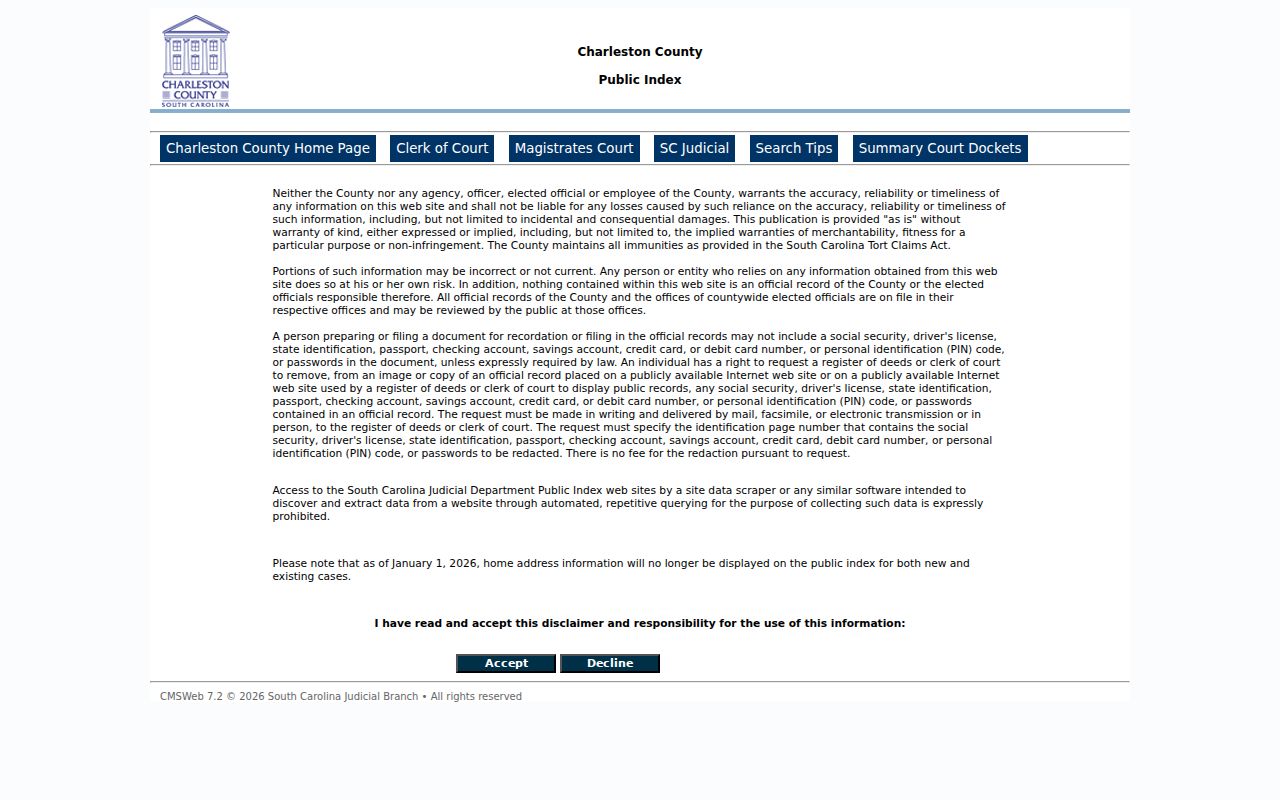
Use the court contact when the index does not answer a status question.
Issuing and Serving Warrants in Charleston County
Warrants in Charleston County come from several benches. County magistrates take misdemeanor, traffic, bond, and preliminary matters. City judges handle municipal cases inside their own limits. The Ninth Judicial Circuit's General Sessions and Family Court sit here too, along with a federal court. The Clerk of Court keeps Circuit and Family records, while each lower-court clerk keeps a separate docket. Service works the same way in pieces: the Sheriff's Warrants Unit serves county process it has received, and city police may hold or serve municipal warrants. Remember that the court issues the legal process, so a service record settles nothing about the case itself. Ask the clerk which office can copy it, and ask the Warrants Unit whether the Sheriff has received it.
Clerk of Court
Charleston County Judicial Center, 100 Broad Street
(843) 958-5000
Charleston County Warrant Confirmation
Charleston County runs its warrant confirmation in person, at the Warrants Office in the main lobby of the Sheriff Al Cannon Detention Center, 3841 Leeds Avenue. Doors are open Monday through Friday, 7:00 a.m. to 5:30 p.m., minus county holidays, and a quick call ahead is smart. For some VCL warrants the office offers appointment-based voluntary surrender, though the judge alone sets bond and decides release. After hours, dispatch handles urgent status questions. The county uses two numbers for different dispatch contexts: Consolidated Dispatch at (843) 202-1700 and non-emergency dispatch at (843) 743-7200, so follow whichever number the current official instruction gives. Save 911 for true emergencies. Skip emailing sensitive identifiers unless the office lays out a secure method, and ask instead what details are needed, whether a lawyer can make the inquiry, and where to appear if an appearance is required.
If You Have a Warrant in Charleston County
Start by confirming the issuing court, the warrant type, and its current status. Everything else follows from that. Ask the office which procedure applies, whether you need an appointment, what identification and papers to bring, where a bond hearing happens, and whether payment or a court motion matters. A South Carolina lawyer can help you plan a safe appearance and pursue a motion to recall or quash the warrant. For certain warrants, CCSO outlines a simple path: call, book an appointment at Bond Court, appear before a deputy, then attend a bond hearing. A personal-recognizance bond may be on the table, but release is never guaranteed. Missed a magistrate date? Contact that magistrate first. Municipal courts in Charleston County work differently, and paying online can still leave an appearance requirement standing.
Do not rely on a name match or walk into an unfamiliar building without confirming the correct office and steps. Keep receipts, court orders, bond terms, and the next court date.
Charleston County Warrant Records and Public Access
South Carolina FOIA gives you the right to inspect or copy many public records, exemptions and redactions aside. The Sheriff's form covers one specific record, not a bulk warrant roster or an emergency status check. It wants the record type, case number if known, dates, enough subject detail to separate your file, location, and your contact information. Ask for an estimate before approving any staff search or copy costs. State law governs arrest and search warrant rules, while Family Court and juvenile records carry their own privacy limits. A sealed or restricted record may simply not show up in a public search. And remember: a FOIA response never clears a warrant.
Relevant access rules:
South Carolina FOIA, Title 30, Chapter 4, governs public inspection and exemptions.
S.C. Code Title 22 addresses Summary Court arrest-warrant authority and copies.
Juvenile confidentiality law restricts identifying court and law-enforcement records.
South Carolina Has No Warrant Portal
South Carolina offers no public statewide warrant search. SLED CATCH sells criminal histories, but its own notice says wanted-person information is excluded. The SLED and NCIC systems law enforcement uses are not public self-check databases, so a Charleston County warrant question still goes through local offices.
Charleston County Federal Warrant Record Route
Federal matters call for official District of South Carolina or U.S. Marshals contacts. PACER can display public case activity, yet sealed records and warrant data leave it far from a complete public index. City matters are different. The issuing city is the right first stop there. None of these limits close the door. They simply mean you should identify the court, then ask the office holding that record for confirmation.
Charleston County Warrant Workload
CCSO's April 2025 monthly report breaks warrants into received, served, and returned by category. That month it logged 123 received, 183 served, and 13 returned. Treat those unit totals as activity measures, not unique people or a live count of open Charleston County cases, since amended charges, expungements, and timing all shift historical figures. Charleston Police reported separately that its Warrant/Bond Court Unit served 628 warrants in 2023. Keep that city figure apart from CCSO's county report. Aggregate counts explain the workload without exposing names, photographs, or private case details.
Charleston County Warrant Privacy
Use these systems to check your own status, help a relative find the right office, or learn how to obtain a warrant record. Never use a search result to locate, follow, threaten, or confront another person. A similar name proves little, and a public record may miss corrections or later court action. CrimeStoppers takes anonymous tips, but it is no warrant confirmation desk. Call 911 only for emergencies. For your own standing, use the Warrants Unit or the issuing court. Juvenile and sensitive Family Court material deserves extra care, so public pages should never reproduce names, photographs, home addresses, or case identifiers from Charleston County files.
Charleston County Warrants by City
City boundaries decide which municipal court handles a citation, so the city pages here follow the 2020 Census population order. Summerville and Goose Creek spill past the practical county service area, and their city records are not always Charleston County records. Check the issuing city before assuming which court holds your warrant.
Charleston Warrant Search
Lockwood Boulevard Municipal Court and the city police Warrant Unit.
North Charleston Warrant Search
City eCourt searches, case fields, and payment posting delays.
Mount Pleasant Warrant Search
Municipal Court, police records, and local bond procedures.
Summerville Warrant Search
Municipal Court and Police Warrant Division routing.
Goose Creek Warrant Search
Direct court contact where no public warrant form was located.